
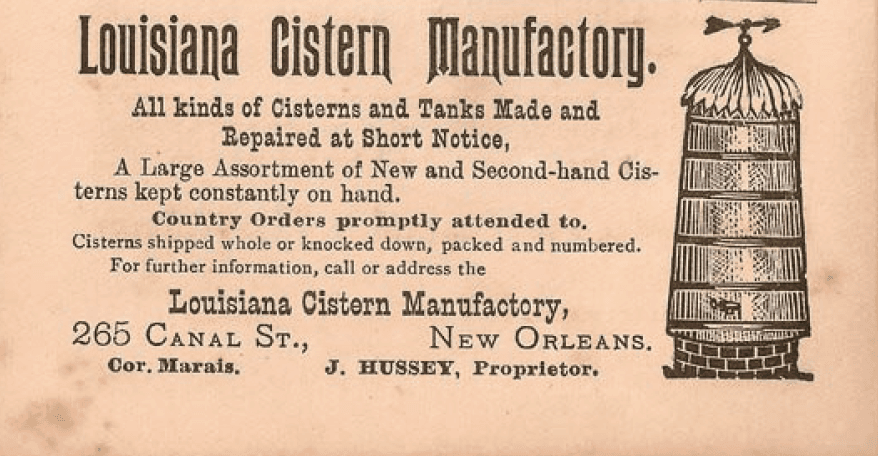
The city leaks everywhere. Fire hydrants leak, water burbles up from the ground. New Orleans loses a lot of water. When you see a hole in the street filled with gravel, it's Sewerage & Water Board (S&WB). Most roped off holes and cones belong to them, too. Before there were pipes in the ground New Orleanians got their drinking water from cisterns.
In 1916, the city made cisterns illegal.
New Orleans Cisterns: Where Did Our Drinking Water Come From?
It's very rare to see a cistern in the city nowadays. If you do, it's decorative, like the one on the side of the Benachi House (diagonally across from La Belle Esplanade). You can see it on the North Tonti Street side.
You can also see one if you take a tour of the Hermann-Grima House, which I recommend. It's beautiful in there. I think that's on Chartres Street in the French Quarter.
You just pronounced Chartres wrong.
Before the Sewerage & Water Board
For much of New Orleans history, drinking water came from the sky. Rain fell on rooftops, ran through gutters, and collected in enormous wooden cisterns. Think of two-story tall barrels next to every house.
The Mississippi River supplied plenty of water, but it was muddy. Wells weren't much better. Groundwater was often unpleasant to drink. Households without sufficient rainwater bought river water from vendors who delivered it by wagon.
New Orleans supported numerous cistern manufacturers, carpenters, and deliverymen. In 1909, Rigamer & Wahlig advertised its factory at 390 Esplanade Avenue as the "Largest Cistern and Tank Factory in the South." The factory's long gone. It's the Spicy Mango, now. If it's not the Spicy Mango while you're here, it will be something else. It's a good business location, at the beginning of Frenchmen Street.
The End of the Cistern
Municipal water treatment arrived in the early twentieth century. The Sewerage & Water Board began supplying purified drinking water in 1909.
Cisterns also presented a public-health problem. Standing water provided breeding places for mosquitoes, and mosquitoes transmitted yellow fever. In 1916, New Orleans prohibited cisterns.
Thousands of the old wooden tanks gradually disappeared from backyards and courtyards.
New Orleans' Finest
La Belle Esplanade was built in 1883. Our cistern was torn down long ago, not even a memory. We get our drinking water like everyone else, fresh from S&WB, New Orleans' finest!
We've come a long way from collecting rainwater in wooden barrels. Whether every change has been an improvement is another question.
Next time you're walking along Esplanade Avenue, take a look at the old cistern across the street. It's a surviving piece of the infrastructure that once made everyday life in New Orleans possible.